


|
|
Recent articles by Boris
Métro, boulot, tombeau : le nouveau confinement Nov 01 20 Loi travail 2017 : Tout le pouvoir aux patrons ! Sep 08 17 Partenariats public-privé: Les marchés publics aux mains des privés Jan 09 13 The useful myth of "chancers" (workers on sick leave, the unemployed...) france / belgium / luxemburg |
economy |
opinion / analysis france / belgium / luxemburg |
economy |
opinion / analysis
 Tuesday November 29, 2011 21:21 Tuesday November 29, 2011 21:21 by Boris - Alternative Libertaire by Boris - Alternative Libertaire
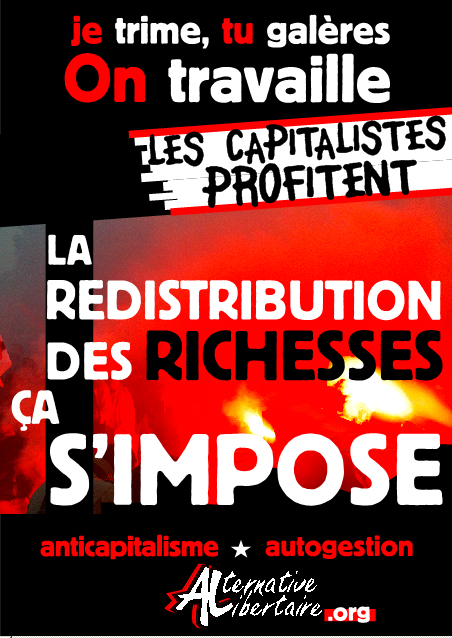
 Sarkozy the candidate and the UMP (Union for a Popular Movement) had guaranteed that they would have no trouble in attacking all those who dared to abuse the French social welfare system. A promise made is a promise to be kept: in these times of economic crisis it is now a priority to act against workers on sick leave and the unemployed. [Français] The useful myth of "chancers" (workers on sick leave, the unemployed...)The candidate Sarkozy and the UMP (Union for a Popular Movement) had guaranteed that they would have no trouble in attacking all those who dared to abuse the French social welfare system. A promise made is a promise to be kept: in these times of economic crisis it is now a priority to act against workers on sick leave and the unemployed. Responsibility: this is the magic formula, repeated constantly by government members. "It does not encourage responsibility if, whenever you get sick, it does not affect your benefits and your salary," said Laurent Wauquiez for example, with his usual arrogance [1], taking up the old refrain the right and the extreme right [2] which has continued to criticize, in recent years, the social gains won over the years by waged workers. Drawing the conclusions from this fallacious talk, the right decided in November to increase from three to four days the waiting period for private-sector workers - i.e. the time during which workers on sick leave do not receive sick pay. Moreover, in the public sector, officials now have to undergo a waiting period of one day as well. A measure of fairness, spokespersons of the UMP cry to all and sundry, trying to pit workers against each other, but the reality is somewhat different. In fact, a number of private companies guarantee, on the basis of individual collective agreements and from their own funds, the payment of sick pay to employees during the three-day waiting period. According to the optimistic - and very Sarkozistic - Christian Jacob, nearly 75% of companies smooth over the shortcomings of the social security system this way. Whatever the truth of these proportions, it is clear that the extension of the period will contribute to a breakdown of the percentage in question. Therefore, all employees will no longer be equal in the eyes of illness. Public agents - officials or otherwise - in turn will find themselves in a new situation and do not have this type of support. Their benefits will presumably have to be adjusted, at the cost of an upward revision of their contributions. Ultimately, it is private sector employees working in SMEs who will suffer most from this reform, because their employers cannot afford to pay them during the waiting period. However, it is in this sector that we find a significant number of people who perform strenuous jobs, and who are therefore more at risk of injury. Many doctors have also denounced this blatant injustice, like Claude Leicher, president of the general practitioners' union, MG France [3]. When you know how many employees don't take sick leave out of fear of losing their jobs, already experiencing the effects of pressure at work that implies that sick working men and women are only "chancing their arm", unremorsefully squandering public money, it is simply a scandal. Especially when you consider Sarkozy's policy since hw was elected: distribution of generous tax breaks to the rich at the start of his term, followed by a massive and unconditional bailout of the banks... Social security reform is only one element among many in this consecration of inequality. Witness, for example another decision last November, which requires recipients of RSA (Revenu de solidarité active, a pay supplement for low-paid workers) to work for 7 hours in order to receive the benefit, thus creating a reserve army of casual workers, instead of promoting the creation of new jobs. The general line is clear: establish those who experience the destructive consequences of capitalist exploitation as being the guilty parties.
Boris
1. Statement made on BFM-TV/RMC on 16 November 2011.
Translation by FdCA-International Relations Office.
Add Your Comments >>
 printable version
with comments printable version
with comments
   |
Front pageSupport Sudanese anarchists in exile Joint Statement of European Anarchist Organizations International anarchist call for solidarity: Earthquake in Turkey, Syria and Kurdistan Elements of Anarchist Theory and Strategy 19 de Julio: Cuando el pueblo se levanta, escribe la historia International anarchist solidarity against Turkish state repression Declaración Anarquista Internacional por el Primero de Mayo, 2022 Le vieux monde opprime les femmes et les minorités de genre. Leur force le détruira ! Against Militarism and War: For self-organised struggle and social revolution Declaração anarquista internacional sobre a pandemia da Covid-19 Anarchist Theory and History in Global Perspective Capitalism, Anti-Capitalism and Popular Organisation [Booklet] Reflexiones sobre la situación de Afganistán South Africa: Historic rupture or warring brothers again? Death or Renewal: Is the Climate Crisis the Final Crisis? Gleichheit und Freiheit stehen nicht zur Debatte! Contre la guerre au Kurdistan irakien, contre la traîtrise du PDK Meurtre de Clément Méric : l’enjeu politique du procès en appel |
 make this your Anarkismo.net front page


 Digg this
 del.icio.us
 Furl
Furl Reddit
 Technorati
 Facebook
 Twitter
|
